jwg: (EvilGrin)
Halloween in Cambridge was absolutely quiet. Not a single visitor to the door - that seems typical around here. Although I'd gotten email from several city council candidates who were soliciting volunteers to go around door-to-door - so I assume they were out.

Last year we were in Lima, Peru on the Day of the Dead and visited several cemeteries which were jammed with people.

I did write about this last year.

Here is one of the huge arrays of graves:


Speaking of Peru - Peru, MA got 32 inches of snow. - we had a dance camp there a few years ago.
jwg: (MachuPicchu)


We climbed up to the SunGate which is the entrance to Machu Picchu from the Inca Trail and was the place where Hiram Bingham first encountered it. It is at 8,924 feet and gives a good view of the site since it is about 1,000 feet above it. The zig zag line in one of the pictures is the road that the busses use to get from Aguas Calientes to the site. The mountain on the other side is Huayna Picchu and is a bit higher. One of our group climbed it but most of us opted for the SunGate which was an easier hike. (8-9,000 feet feels a lot lower than the 11-12,000+ feet of Cusco and its surroundings).

There were a number of llamas roaming around - mostly with some identification on their ears. There were a few flowers scattered in chunks in the rocks - we saw several lizards basking in the sun and there was a rodent as well. Most of the fauna were humans. Late morning there were about 1,000 wandering about but late in the afternoon or earlier in the morning it was sparsely populated and I was able to take quite a few pictures with no people visible.

Click here for a Flickr set ->
The trip from the top of Huayna Picchu to Machu Picchu.
jwg: (MachuPicchu)
The Incans had no form of writing so there is no written record but what is known is based upon oral tales passed on through generations and the work of arceologists and historians.

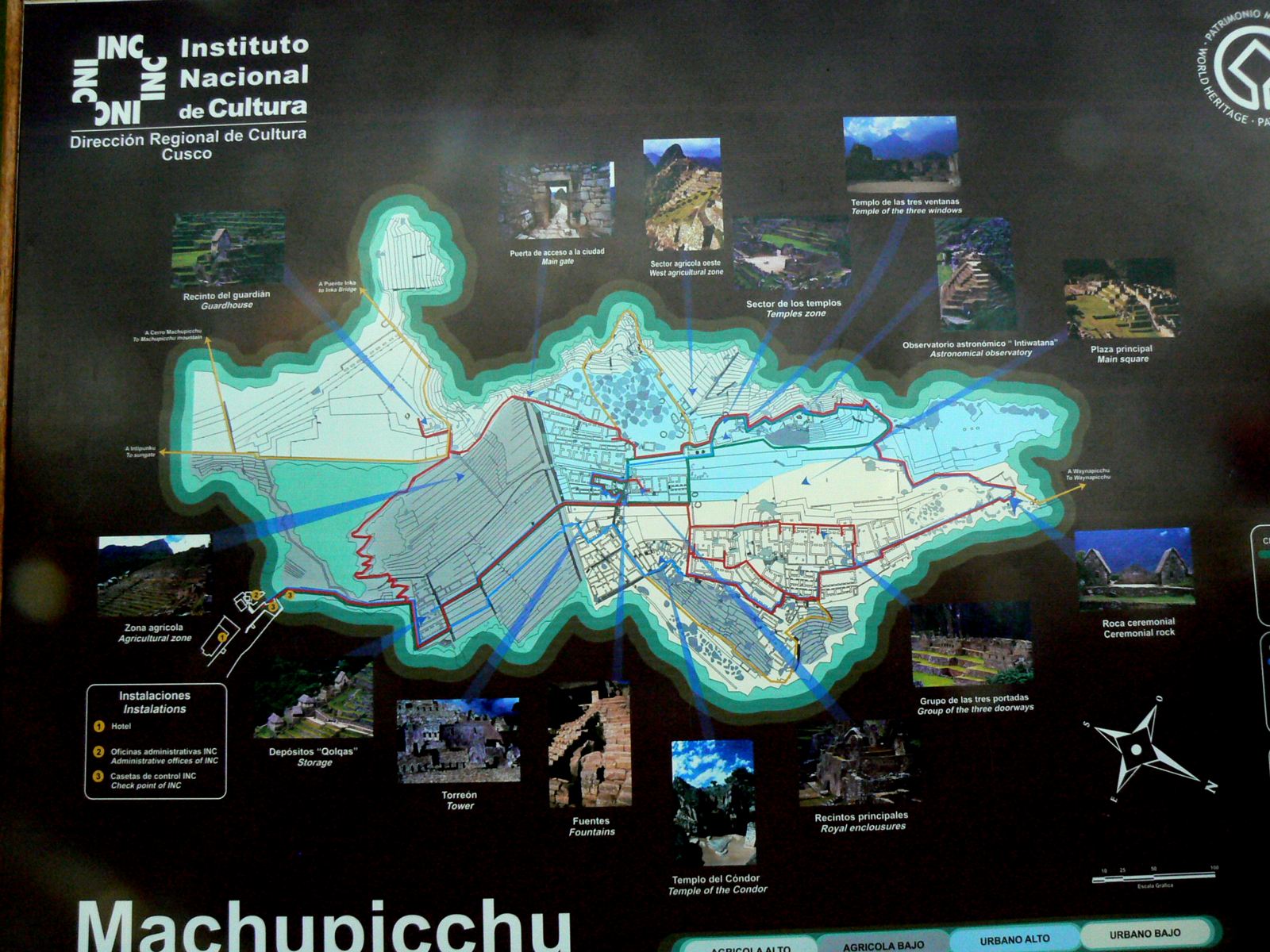
Machu Picchu was built around 1460 by a group led by Pachuacuo Onca Yupanqui, one of the most effective Incan rulers. It is thought that it was to be a royal estate and religious retreat; it contains residences as well as various public buildings. The structures are built with granite blocks cut with stone or bronze tools and smoothed with sand. The blocks fit together well; no mortar was used. The walls slant a bit probably to make the structures more stable. They used thatched roofs and some have been reconstructed. Corn and potatoes were grown on the terraced gardens.

About 90 years later it was abandoned; perhaps because many people died from small pox but also they were trying to protect it from the Spanish invasion. It was clearly built in a hard to find and reach place that could be defended. They obliterated the trail to it when they left and the Spaniards never did find it. Some of the locals knew where it was and helped Hiram Bingham find it in 1911.

Click here to embiggen map:

A 25 sec video tour

Click here for Flickr set ->
jwg: (MachuPicchu)
I saw some photographs of Machu Picchu about 45 years ago and knew that I wanted to go there. Finally we did and set off on the train from Cusco on the morning of Nov 4. We were supposed to go in March after our trip to the Galapagos but severe rain storms in January washed out the railroad and closed the resort.

Here is the first view as we came in the entrance:


I must tell a side story from long ago. When I was about 12 years old I was visiting a friend in NW Connecticut at the end of the summer and the golf course needed some caddies. I went there and there these four elderly gentlemen who needed caddies. I became the caddy of one of them and he introduced himself as Hiram Bingham. I caddied for him a few days. I learned that he had been the governor of Connecticut and also a Senator; he and his friends talked about political stuff a lot. (I don't remember how well he played golf.) It was only some years later that I learned that his real fame was the discovery of Machu Picchu in 1911.

Click here for photos of the trip there->
jwg: (EvilGrin)
While staying in Cusco we took several bus tours to nearby places in what is called the Sacred Valley of the Incas. There we saw some Inca structures and terracing which they used to do farming on hillsides and got some some good views of the surrounding countryside. The Incas were good architects and engineers (and astronomers). Their mortarless stone structures lasted well and some were used by the Spaniards as foundations for their buildings.

The first day was tough since we had just gotten to the higher altitude of Cusco (11,300ft) and some of these sites were even higher. Most people had trouble sleeping the first night. I could hear and feel my heart beating for hours while lying awake in bed. Another day in Cusco with nothing much happening on the first one would have been better.

Click here for a Flickr set ->

Cusco

Nov. 22nd, 2010 07:22 pm
jwg: (Frigate)
After Lima we flew to Cusco to explore it and its surroundings and then go to Machu Picchu. Cusco is the gateway to Machu Pichuu - the only way to get to Machu Picchu other than by foot is via train from Cusco.

Cusco has a long interesting history. It was headquarters for various indian tribes and in particular it and the surrounding fertile valley and hills were dominated by Incas. One of it's key leaders, Yupanqui, was strong on uniting the various tribes. (too bad he isn't around today. ) After his success he was renamed Pachakuteq Inka Yupanqui. His architects designed the city to be in the shape of a Puma. Sanctuaries were aligned with the stars. For more details see this article (veracity not confirmed). Our guide who explained lots of things (too many for some people) did not cover this. Later of course the Spaniards invaded Peru (Pissaro in 1534) and their influence is seen in many of the buildings - many of which are build on top of Inca foundations. It's interesting to think about how the Spaniards occupied the west coast of South America which required some extremely difficult traveling since you had to sail around the tip of South America which is quite treacherous.

We had several quick trips to plazas, churches, and convents in central Cusco. The main square was a couple of blocks from our hotel (it's where the bus parked to let us on or off). Cusco is a big city with a rapidly growing current population of almost 400,000 - of course that's small compared to Lima which is ~8 million. It is definitely a fascinating place and I wish we had more time to explore there.


Click here for some pictures ->

Click here for pictures
of children in the square->
jwg: (beard)
On our first day in Cusco; while still attempting to adjust to the altitude (11,200 feet) we went on a bus trip into the Sacred Valley of the Incas. One of the things we did was to visit a farm near Cusco where they had alpacas, vicuñas, and llamas. They sheared them, spun and died the resulting wool and native weavers were there as well. Even in this rural setting the light bulbs were CFLs; energy conservation is big in Peru. They explained about the dying process and we got to feel all the lovely wool they had hanging there. The camelids were mostly just grazing around but there was a bit of activity as seen in this amusing scene (~45 secs):

Click for some Flickr pictures ->

In addition to all the woolwork there were other things as this:

jwg: (Lion)
It was still one day before the official start of the trip but many of us were there. We made a trip into Lima to visit two adjacent colossal cemeteries on the Day of the Dead where we were told there would be huge crowds - and there were. The cemeteries have many huge arrays of graves - a bit like Japanese compartment hotels - but even bigger. There were also lots of more elaborate monuments. There were many people there refreshing flowers and doing other decorations as well. Many vendors selling food and trinkets including some pretty fancy bread and candies. We saw/heard a choir.

The tour guides warned us to be careful and the many police who were present also warned us. It felt perfectly safe. There were huge crowds of people but the place was vast and there was lots of room to wander about. It was an interesting experience and we were all glad we went.

There were many of these structures and lots of people:


Click here for Flickr set ->

The choir and a bit of view (47 sec)

Lima Taxis

Nov. 18th, 2010 03:39 pm
jwg: (JohnBottleLogo)
In Lima there are a lot of taxis made from 3-wheel motor cycles with some flashy decoration. When we went in to join the crowds at the cemetery there were lots of them milling around.


A short video showing a line of them.
jwg: (with camera)
We arrived in Lima late in night (2 am) and after getting our luggage and clearing customs and immigration went to the hotel which was right there. The next morning we, Ken McFarland who is the trip organizer, and Ralph and Ka7 who were the other two people who arrived several days early went into Lima to the Museo de la Nación. It is one of thew archeological museums in Lima and had some pretty terrific of ceramics made by Moche, Wari, and Nasca people who lived in various regions of Peru in the first millenium.

Here is a Flickr album of a bunch of them.

I thought this picture particularly striking. It is someone typing up a list of the order that bodies will be picked up after a massacre by the Shining Path that occurred on Dec 3, 1989 in the town of Orurillo.


The museum itself is a big modern concrete mass (too bad since there are some really nice buildings in Lima) but the inside has some interesting views. Here is one.
jwg: (MachuPicchu)
We're back from a most fabulous trip to Peru and Chile. It was even better than I expected and my expectations were high. I need to work on pictures by selecting a few from the ~1600 I took for some detailed postings but here is a quick summary

- In Lima we toured several cemeteries which were jam packed with people honoring the graves and enjoying themselves on the Day of the Dead and some some historical buildings in the center of town.

- In Cusco and its surrounding area we visited some of the best of the Spanish colonial architecture and some Inca structures.

- In Machu Picchu we spent many hours wandering about the ruins and climbing to the Sun Gate which is where hikers on the Inca Trail get their first view.

- On Easter Island we saw many many Moia including some under construction and some in bad shape.

- We learned a lot about Inca and Rapa Nui history and culture from our two well informed and personable guides.

I've wanted to go to Machu Picchu for a very long time. We were supposed to go in March but heavy rains washed out the railroad so this was the postponed trip which was augmented by a trip to Easter Island. We probably got better weather in Machu Picchu now than in March. The weather was quite good. It was cloudy in Lima (it apparently always is) and there were occasional rain showers elsewhere but they all occurred at night or when we were in a bus traveling to another spot.

Cusco is at 11,300 ft and a bit higher nearby which presented a bit of a challenge to many of us; but everyone did OK, with struggling up stairways and lots of fast pulse rates. Sleeping the first night in Cusco was a challenge.

Profile

jwg: (Default)
jwg

January 2026

S M T W T F S
     123
45678910
11121314151617
18192021222324
25262728293031

Syndicate

RSS Atom

Most Popular Tags

Style Credit

Expand Cut Tags

No cut tags
Page generated Jan. 3rd, 2026 09:11 pm
Powered by Dreamwidth Studios