jwg: (huh?)
I just finished reading a very interesting book: Lost City of the Incas by Hiram Bingham. It was written in 1948 and is about his expedition in 1911 to Peru (and several more over the next few years) where his discovered lots of things about the Incas including the city Machu Picchu. He was a professor of South American History at Yale. He was accompanied by several colleagues and worked with a bunch of local people traversing many ruins. The Incas had o writing so there is jo written record of anything.

I've been to Machu Picchu twice. What an incredible place! The Incas were incredible architects and builders. The buildings are made of huge carved stones that fit together very tightly and used no cement.

Interestingly in 1954 I was visiting a friend in northwestern Connecticut and spent a few days as a caddy at a local golf course and my client was Hiram Bingham! I knew nothing about him at the time but later learned that he had been Connecticut Lt Governor and then Senator a few years after his explorations.


Lots of info and pictures about my trips. https://jwg.livejournal.com/tag/machupicchu/
jwg: (MachuPicchu)
As you can see from some of the pictures in this set there was a small city here. The stone work is in excellent shape. A few buildings have reconstructed thatched roofs on them. There is also lots of terracing which was presumably used to grow food and to make some of the area traversable. There is an elaborate drainage system to help the water flow in an orderly fashion.

It is so much fun and so interesting to just walk around gaping at everything.

The Incas were excellent architects and engineers. The stone walls were constructed very carefully with each stone carved to fit tightly so no mortar was needed. It's not too clear exactly what tools they used for the carving. The building walls all sloped inward a bit to help preserve them over time.

You can see some workers (of several species here) doing site maintenance.

Click here for some pictures
MachuPicchuMore2015FlickrSet.jpg
jwg: (MachuPicchu)
MachuPicchuPanorama.jpg

In about 1450 at the height of the Inca Empire this incredible fortress/city was built. it was abandoned about 100 years later as a result of the Spanish Conquest. In 1911, Hiram Bingham, a Yale professor of history, travelled to Peru and based upon recommendations from local people arrived at it. He returned again in 1912 - with funding from the National Geographic Society and a team with local labor did a lot of clearing of the overgrown site.

There is lots of controversy about its history and role made difficult because the Incas had no writing so there are no records. Bingham is sometimes slammed because people think he gets too much credit for the discovery - but it seems his effort with the National Geographic Society allowed it to be preserved (many other Inca ruins have been wrecked) and become an incredible tourist destination. I'd say just as Columbus discovered America, Hiram Bingham discovered Machu Picchu.

On the first day there it was sunny and clear; on the second day it was cloudy and misty which led to some pretty nice mountain scenes.

Click here for some pictures from our June trip
MachuPicchuFirstViewFlickrSet2015.jpg


Coca leaves help one cope with altitude. Every place serves coca tea and you can chew the leaves.
jwg: (RomeFountainMan)
To get to Machu Picchu from Cusco the standard way is to take the train from Ollantaytambo to Aguas Calientes. the town at the base of Machu Picchu. It;s a nice train and they serve a snack and there was entertainment (and sales) by some of the train staff - suitably costumed. We stayed in a nice hotel in Aquas Calientes for one night. We arrived early in the morning and went up that day to see "it". And then returned again the next morning for another view. There is a hotel on top (where we had lunch) but it is very expensive. You go from Aguas Calientes to the site by bus up a zigzagging road - and down again of course

You can also take a 4 or 5 day hike to get there - for much hardier souls of course. I think it comes with porters.

Aguas Calientes is a nice little compact town on the Urubamba River. (Flooding due to major rains wiped out the train line in2010 and caused our trip then to be delayed until the fall.)

Click here for some pictures of things seen along the way and in town.
OntoAquaCalinetesFlickrSet.jpg


This short video give a view of the town and you see it is surrounded by mountains.
jwg: (MachuPicchu)
This June [livejournal.com profile] rsc and I travelled to Peru. It was technically 3 consecutive Ken McFarland trips:
Cusco/Machu Picchu,
a Boat on the Amazon,
and Arequipa/Colca Canyon.

Cusco, a gorgeous Colonial Spanish city that is now very large with some Inca ruins, is delightful (a bit challenging to start the trip since it is at ~11,000 feet). Machu Picchu is so completely amazing (this was a return trip for us since we were there in 2010). Thank you Hiram Bingham for publicizing it and helping make sure it was preserved.

The Amazon trip was on the Amatista, a lovely boat (30 passengers) on the Amazon and two tributaries: Marañón and Ucayali. Fascinating views, Pisco Sours, lots of trips in little boats and walking in the jungle to see birds, natives, a boa,... A most amazing experience.

Arequipa is another colonial city surrounded by mountains and volcanos and has had several serious earthquakes. The road from Arequipa to Cabanconde at the head of the canyon went through a pass that was at 16,100 feet - we walked around very slowly. The Colca Canyon is one the worlds deepest (~10,000 feet). We descended mostly by small bus down the windingest road I have ever seen with a short hike down a few more hundred feet to a completely isolated village.

I will be making a bunch more posts over the next few days - carefully selecting some of the 4,000+ pictures I took.

Click here for a few photos:
Peru-2015-Overview.jpg
jwg: (MachuPicchu)
I just finished reading Turn Right at Machu Picchu by Mark Adams. A delightful book (paperback is on the best sellers list) about Hiram Bingham, Machu Picchu and a lot of other information about the mystery of the Incas, and the controversy about Bingham's role. Adams is an author who decided to do some serious traveling to Peru; the book is a mixture of history, speculation, and his own reaction to the various people he worked with. I went to Machu Picchu in October of 2010.

I wrote to him with my Hiram Bingham story:

==
At the end the summer in 1951 when I was 13 (I might be off by a year) I was visiting a schoolmate in Sharon, Connecticut for a couple of weeks. It turned out that the golf course at Sharon Country Club needed several more caddies since some of the regular ones there for the summer had left. So I decided to give it a try.

The first day there was a group of 3-4 older gentlemen and one of them needed a caddie. I introduced myself to him and he said his name was Hiram Bingham. I caddied for him about four or five times. Those were the days when golfers walked and caddies carried their bags. I don't remember how good his game was. I don't know if I had heard of Machu Picchu (although that year in 7th grade I studied South American history so knew a bit about Peru and the Incas) and I don't recall that he talked about it to his cronies. I did learn that he'd been Governor and Senator. He and his golfing buddies did seem to talk about political things, but trying to be a good caddie I stayed in background and didn't hear much. I wasn't a golf expert but I had gone to driving ranges with my father many times, practiced putting on our lawn, knew a lot about golf from my parents, and was a good miniature golf player. Mr Bingham, as I called him, complemented me about my caddying.

I kind of think that I am of the few people in the world who interacted with him for a few hours several times and it had nothing to do with Incas or politics. The first time I saw a picture of Machu Picchu I made the connection in my mind and going there was on my list.
===
He responded with this picture of Bingham with a set of golf clubs.
jwg: (MachuPicchu)
In the Dec 19 NewYorker there was an article by Alec Wilkinson about Ashrita Furman, the person who has the record for the most Guinness records. Furman, who is fifty-seven and the part owner of a health-food store in Queens, is the world’s leading practitioner of a pursuit that is known as Guinnessport—the undertaking of challenges designed to get a person into an edition of Guinness World Records.

He currently (or at the time of the article) holds 131 and has had 367. Making these records involved learning 70 discrete skills that he has learned - an example is slicing apples with a samurai sword.

Some examples:

- His first record: 27,000 jumping jacks in 6:45 was his first record.

- A mile on a hop ball on the Great Wall of China in 15 ins and 3 secs.

- Jumped underwater on a pogo stick in the Amazon for 3:40

He failed to climb Cerro Machu Picchu on stilts - at 10,009 feet would have been the highest mountain climbed that way but he was turned away by security.
jwg: (JohnBottleLogo)
This year we went to South America twice. In March we went to the Galapagos. And in November we went to Peru primarily to go to Machu Picchu and Easter Island. Originally the Machu Picchu visit was to be after the Galapagos trip but major rain storms in Peru in January washed out the railroad and the site was closed to visitors since there was no way to get there - and Aqua Calientes, the village at the base, was flooded too. This turned out to be a boon since the Machu Picchu trip was rescheduled to November and the opportunity to go to Easter Island arose.

These were two incredible trips - both organized by Ken McFarland - the Greek Island trip in 2007 and the Tanzania trip in 2008 were his also. In March we go to Egypt on one of his trips.

Highlights of the Galapagos were blue and red footed boobies, great frigates, land and marine iguanas, tortoises and turtles, sharks, penguins, and lots more. A land iguana )
All my LJ postings for the Galapagos trip are here.

Highlights of the Peru trip were day-of-the dead at Lima Cemeteries, churches in Lima and Cusco, Inca structures near Cusco, and just about everything about Machu Picchu - structures, overall site, history/mystery.
Machu Picchu )

Highlights of the Easter Island trip were the Moai, the carvings, the history/mystery too, the banana sled racing, the native dancing, our dancing, the overall ambiance, the flora, and the volcano crater.
Seven Moai )

My LJ postings of the Peru and Easter Island trip can be found here.

Oh yes, and don't forget the Pisco Sours!
jwg: (MachuPicchu)


We climbed up to the SunGate which is the entrance to Machu Picchu from the Inca Trail and was the place where Hiram Bingham first encountered it. It is at 8,924 feet and gives a good view of the site since it is about 1,000 feet above it. The zig zag line in one of the pictures is the road that the busses use to get from Aguas Calientes to the site. The mountain on the other side is Huayna Picchu and is a bit higher. One of our group climbed it but most of us opted for the SunGate which was an easier hike. (8-9,000 feet feels a lot lower than the 11-12,000+ feet of Cusco and its surroundings).

There were a number of llamas roaming around - mostly with some identification on their ears. There were a few flowers scattered in chunks in the rocks - we saw several lizards basking in the sun and there was a rodent as well. Most of the fauna were humans. Late morning there were about 1,000 wandering about but late in the afternoon or earlier in the morning it was sparsely populated and I was able to take quite a few pictures with no people visible.

Click here for a Flickr set ->
The trip from the top of Huayna Picchu to Machu Picchu.
jwg: (MachuPicchu)
The Incans had no form of writing so there is no written record but what is known is based upon oral tales passed on through generations and the work of arceologists and historians.

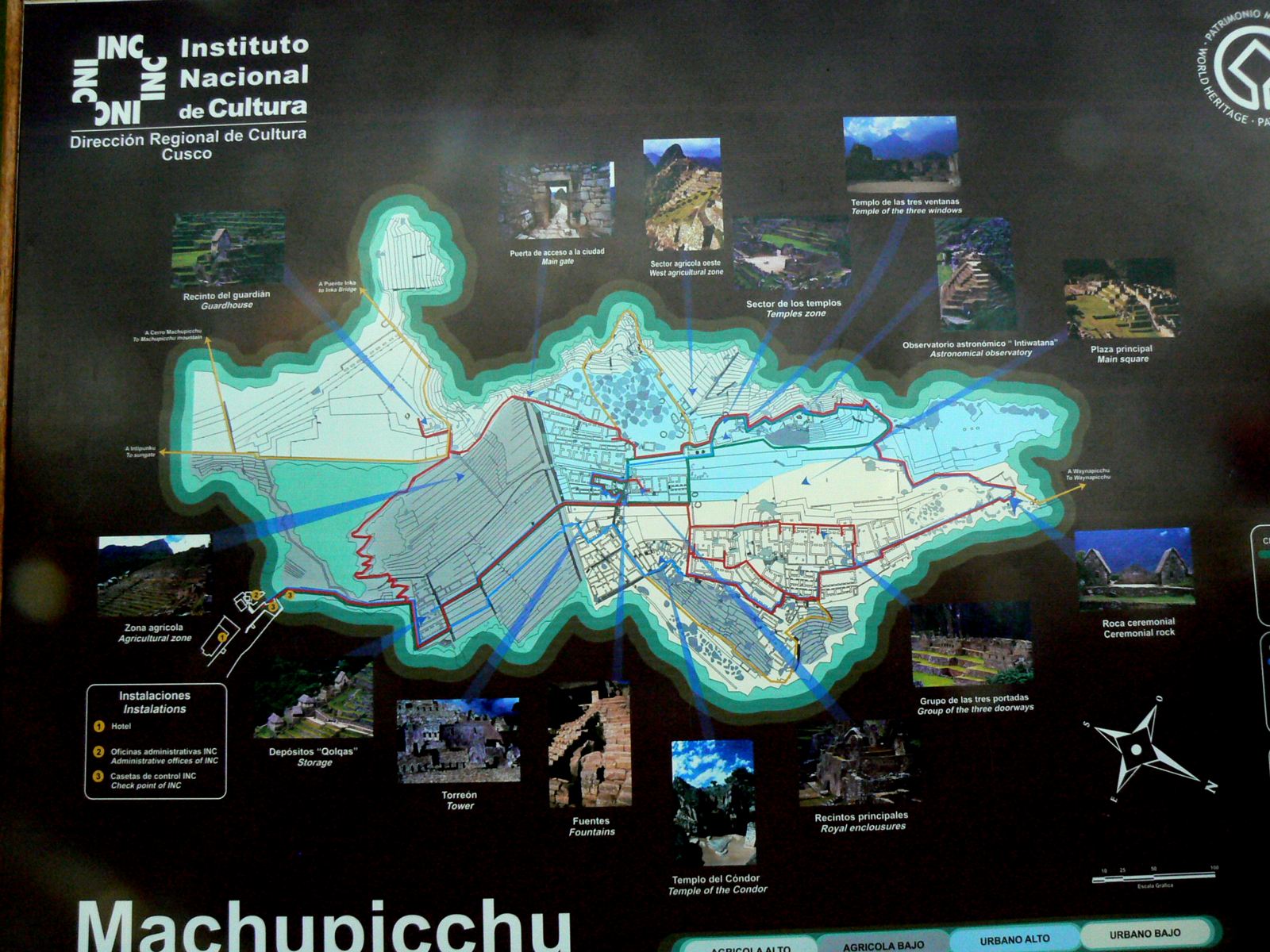
Machu Picchu was built around 1460 by a group led by Pachuacuo Onca Yupanqui, one of the most effective Incan rulers. It is thought that it was to be a royal estate and religious retreat; it contains residences as well as various public buildings. The structures are built with granite blocks cut with stone or bronze tools and smoothed with sand. The blocks fit together well; no mortar was used. The walls slant a bit probably to make the structures more stable. They used thatched roofs and some have been reconstructed. Corn and potatoes were grown on the terraced gardens.

About 90 years later it was abandoned; perhaps because many people died from small pox but also they were trying to protect it from the Spanish invasion. It was clearly built in a hard to find and reach place that could be defended. They obliterated the trail to it when they left and the Spaniards never did find it. Some of the locals knew where it was and helped Hiram Bingham find it in 1911.

Click here to embiggen map:

A 25 sec video tour

Click here for Flickr set ->
jwg: (MachuPicchu)
I saw some photographs of Machu Picchu about 45 years ago and knew that I wanted to go there. Finally we did and set off on the train from Cusco on the morning of Nov 4. We were supposed to go in March after our trip to the Galapagos but severe rain storms in January washed out the railroad and closed the resort.

Here is the first view as we came in the entrance:


I must tell a side story from long ago. When I was about 12 years old I was visiting a friend in NW Connecticut at the end of the summer and the golf course needed some caddies. I went there and there these four elderly gentlemen who needed caddies. I became the caddy of one of them and he introduced himself as Hiram Bingham. I caddied for him a few days. I learned that he had been the governor of Connecticut and also a Senator; he and his friends talked about political stuff a lot. (I don't remember how well he played golf.) It was only some years later that I learned that his real fame was the discovery of Machu Picchu in 1911.

Click here for photos of the trip there->
jwg: (MachuPicchu)
We're back from a most fabulous trip to Peru and Chile. It was even better than I expected and my expectations were high. I need to work on pictures by selecting a few from the ~1600 I took for some detailed postings but here is a quick summary

- In Lima we toured several cemeteries which were jam packed with people honoring the graves and enjoying themselves on the Day of the Dead and some some historical buildings in the center of town.

- In Cusco and its surrounding area we visited some of the best of the Spanish colonial architecture and some Inca structures.

- In Machu Picchu we spent many hours wandering about the ruins and climbing to the Sun Gate which is where hikers on the Inca Trail get their first view.

- On Easter Island we saw many many Moia including some under construction and some in bad shape.

- We learned a lot about Inca and Rapa Nui history and culture from our two well informed and personable guides.

I've wanted to go to Machu Picchu for a very long time. We were supposed to go in March but heavy rains washed out the railroad so this was the postponed trip which was augmented by a trip to Easter Island. We probably got better weather in Machu Picchu now than in March. The weather was quite good. It was cloudy in Lima (it apparently always is) and there were occasional rain showers elsewhere but they all occurred at night or when we were in a bus traveling to another spot.

Cusco is at 11,300 ft and a bit higher nearby which presented a bit of a challenge to many of us; but everyone did OK, with struggling up stairways and lots of fast pulse rates. Sleeping the first night in Cusco was a challenge.

Profile

jwg: (Default)
jwg

March 2025

S M T W T F S
      1
2345678
9101112131415
16171819202122
232425 26272829
3031     

Syndicate

RSS Atom

Most Popular Tags

Style Credit

Expand Cut Tags

No cut tags
Page generated Dec. 24th, 2025 05:41 am
Powered by Dreamwidth Studios